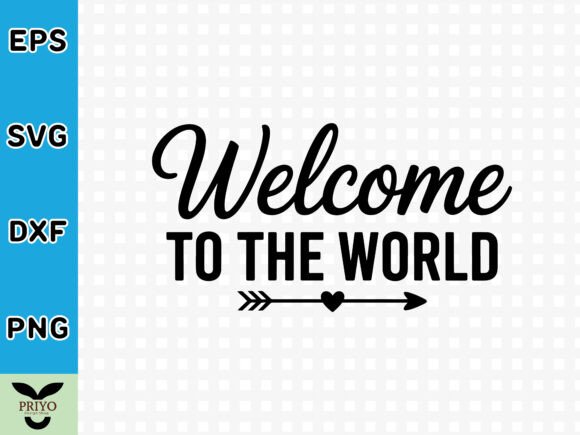
Welcome to the World SVG
First Impressions: Soft, Warm, and Thoughtfully Composed
Opening Welcome to the World SVG feels like unfolding a handwritten note from a trusted friend — gentle, intentional, and quietly confident. It’s not flashy or overly ornate, but it carries warmth through its balanced layout and graceful letterforms. The design leans into organic curves and subtle spacing, suggesting care rather than speed. As an embroidery designer who’s stitched hundreds of “welcome” motifs for baby gifts, boutique aprons, and nursery wall hangings, I immediately sensed this one belongs in the category of handmade product that invites touch — not just sight.
A Real Project Test: Embroidering a Linen Baby Tote Bag
Last week, I used Welcome to the World SVG on a natural linen tote for a client’s newborn announcement gift. The fabric was medium-weight, slightly textured, and unforgiving of dense stitching. I chose a light tear-away stabilizer and tested first on scrap — critical, because the design includes delicate interior curves and modest flourishes around the word “World.” What stood out wasn’t just legibility after stitching, but how the phrase settled into the fabric: calm, unhurried, and deeply personal. Customers don’t just buy words — they buy feeling. And this design delivers that without shouting.
Where It Shines (and Where It Needs Care)
Welcome to the World SVG works beautifully across several high-demand craft business applications:
- Baby embroidery: Perfect for onesies, burp cloths, and keepsake blankets — especially when paired with soft pastel thread colors and low-density fill stitch.
- Tote bag design and sweatshirt embroidery: Its horizontal flow and moderate height make it ideal for center-chest placement or lower-back positioning on relaxed-fit apparel.
- Embroidered patch and nursery decor: Clean lines hold up well when digitized for applique design or cutwork, and it scales nicely from 3" to 5" without losing clarity.
- Holiday embroidery and wedding gifts: While not seasonal, its timeless tone fits beautifully on monogrammed tea towels, pillow covers, or custom kitchen linens for new homeowners or couples starting a family.
That said, use caution in these real-world situations:
- On stretchy fabric like knits or lightweight jersey — test stabilizer pairing thoroughly; running stitch outlines may waver without proper support.
- For curved surfaces like caps or structured hats — the horizontal layout doesn’t wrap naturally, so consider repositioning or simplifying outer elements before digitizing.
- When stitching on dark fabric — review thread color contrast early. Lighter satin stitch areas can fade visually if stitch density is too low or thread sheen is muted.
- In tiny hoop sizes under 4", avoid shrinking below 3.25" wide — fine interior details (like subtle serifs or connecting strokes) risk becoming indistinct or stitching inconsistently.
Design Integrity Meets Customer Trust
As an Etsy seller and small shop product developer, I pay close attention to how a design affects perceived value. Welcome to the World SVG elevates handmade presentation not through complexity, but through restraint. It avoids trendy embellishments that date quickly — no excessive swirls, no forced script fusion, no unnecessary shadows or gradients. That means your finished product looks intentional, professional, and cohesive with your brand voice — whether you’re selling personalized gifts on Etsy or curating a boutique collection of nursery essentials.
Customers notice when a design feels *designed*, not just assembled. This one does. It reads clearly at arm’s length, holds up after repeated washing (especially with proper stabilizer and quality thread), and supports — rather than competes with — the texture and color of your base material.
Practical Embroidery Designer Notes
Before stitching Welcome to the World SVG in any commercial embroidery or craft business context, here’s what I always do:
- Test on scrap fabric — especially if using textured, dark, or stretchy materials.
- Check thread color contrast in both natural and artificial light — some pale grays or creams vanish on off-white linen.
- Review stitch density in tight curves and letter junctions — over-stitching causes puckering; under-stitching leaves gaps.
- Confirm hoop size compatibility — while the design is versatile, its width may require a 5x7 hoop for comfortable hooping and tension control.
- Inspect small details in your embroidery software — look for stray nodes or overlapping paths that could cause jump stitches or thread breaks.
- Test black-and-white mockups — helps assess visual weight and balance before committing to thread.
- Compare light and dark fabric backgrounds — sometimes a design reads perfectly on white but disappears on navy unless adjusted.
- Use proper stabilizer — medium-weight cut-away works best for apparel; tear-away suffices for stable home décor fabrics.
- Verify licensing — since this is a Graphics file marketed for Crafts, confirm whether it permits commercial embroidery, resale of finished products, or redistribution as part of digital embroidery bundles.
Final Thought: A Design That Serves the Moment
Welcome to the World SVG isn’t trying to be everything. It’s a focused, emotionally intelligent machine embroidery design — one that understands its role in marking beginnings, honoring transitions, and adding quiet meaning to everyday objects. Whether you’re an apparel decorator building a signature baby line, a hobbyist stitching heartfelt holiday embroidery, or a creative entrepreneur sourcing reliable design assets for your next small shop product launch, this file earns its place in your library not because it’s trendy, but because it’s trustworthy.
It reminds us that the most effective embroidery doesn’t shout — it welcomes.