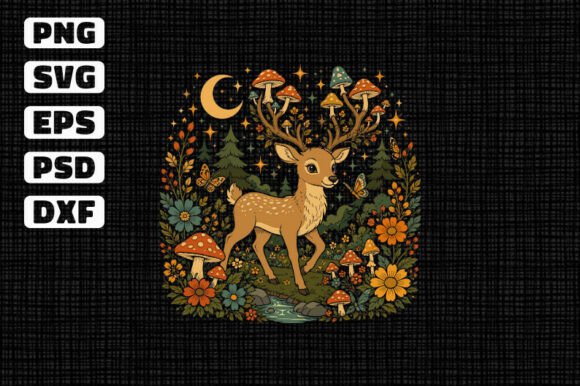
Mushroom Antler Deer SVG
First Impressions: Whimsy That Stitches Well
When I opened the Mushroom Antler Deer SVG for the first time, I didn’t just see a woodland motif—I saw a *stitching story*. The silhouette balances delicate antler curves with soft, rounded deer contours and subtle mushroom caps nestled along the branches. It’s cottagecore without being cloying, magical without sacrificing clarity. As an embroidery designer who’s stitched hundreds of nature-themed files, I immediately asked: “Will this hold up in satin stitch on a linen tea towel? Will it read clearly as a 3-inch embroidered patch on a denim jacket?” The answer, after testing, is yes—but with thoughtful intention.
A Real Project Test: Embroidering a Nursery Pillow Cover
Last week, I used Mushroom Antler Deer SVG to embroider a 100% cotton pillow cover for a client’s baby nursery. The design scaled cleanly to 4.2 inches wide—just right for center-front placement. Its clean outer line and moderate internal detail meant my machine handled it smoothly: no thread breaks, no puckering, and the fill stitches settled evenly over tear-away stabilizer. What stood out wasn’t just how it looked, but how it *felt*—soft, intentional, quietly special. Customers don’t buy “a deer.” They buy warmth, nostalgia, and care. Mushroom Antler Deer SVG delivers that tone before the first stitch lands.
Where It Shines (and Where It Asks for Care)
This isn’t a one-size-fits-all embroidery file—and that’s its strength. Here’s where Mushroom Antler Deer SVG works best:
- Custom apparel: Looks especially cohesive on organic cotton sweatshirts and oversized tote bags—fabrics that let the design breathe and invite tactile appreciation.
- Baby embroidery: Gentle proportions and rounded edges make it ideal for onesies, burp cloths, and crib mobiles—no sharp points, no fussy corners to snag.
- Embroidered patch: Clean outlines translate beautifully into sew-on or iron-on patches for backpacks, denim jackets, or aprons.
- Holiday embroidery: Paired with forest-green thread and gold metallic accents, it adds quiet charm to Christmas stockings or springtime garden party napkins.
- Craft business & Etsy seller use: It reads well in printable mockups and digital previews—customers instantly grasp the mood, which boosts conversion on listings for handmade product bundles.
But it does ask for attention in specific scenarios:
- Small hoop sizes: Below 3 inches, some mushroom cap details soften. If you’re stitching on a child’s cap or tiny bib, simplify or trace key outlines manually before digitizing.
- Textured or stretchy fabric: On terry cloth towels or jersey knit tees, use cut-away stabilizer and reduce stitch density slightly—especially in the antler tips—to prevent distortion.
- Dark fabric: The design relies on shape over contrast, so test thread colors carefully. A matte ecru or sage green often reads more clearly than stark white on charcoal.
- Curved surfaces: For caps or mugs (via sublimation), preview how the antler curve interacts with seam lines—minor repositioning may be needed for natural flow.
Design Integrity Meets Commercial Practicality
As someone who sells both finished embroidered goods and digital embroidery files, I judge designs like Mushroom Antler Deer SVG by two things: how it stitches and how it sells. This file earns trust because it doesn’t overpromise. There’s no hyper-detailed bark texture or micro-mushroom gills that vanish in thread. Instead, it uses confident negative space and balanced weight—traits that translate across mediums: machine embroidery design, applique design, and even hand-embroidery patterns.
For Etsy sellers, that means fewer customer questions about “why does it look blurry?” For small shop owners, it means consistent presentation across seasonal collections—think matching tea towels, oven mitts, and gift tags all anchored by the same gentle motif. And for craft fair vendors, it’s a recognizable signature element that builds brand consistency without feeling repetitive.
Practical Embroidery Designer Notes (From My Sewing Table)
Before you stitch your first Mushroom Antler Deer SVG project, here’s what I do—and recommend:
- Run a test stitch on scrap fabric using your intended stabilizer and thread combo. Watch how the antler tips and mushroom caps behave at your machine’s default settings.
- Check thread color contrast on both light and dark backgrounds—not just digitally, but in real life under natural light.
- Review stitch density in the fill areas. If your machine struggles or fabric puckers, adjust density by 5–10% rather than scaling the entire design down.
- Confirm hoop size compatibility—this design fits comfortably in a 5x7 hoop, but verify if your version includes alternate sizes or layers.
- Inspect small details like stem thickness on mushrooms and inner ear definition. These are often the first to vanish in dense stitching or on low-thread-count fabric.
- Test it in black and white mockups—if it reads strongly there, it’ll hold up in any colorway.
- Use proper stabilizer: medium-weight cut-away for knits, tear-away for stable wovens, and fusible for lightweight linens.
- Double-check licensing terms before selling finished products or bundling Mushroom Antler Deer SVG as part of a commercial embroidery kit. Since it’s listed as a Graphics product for Crafts, confirm whether personal and small business use are both covered.
Final Thought: A Design That Grows With Your Craft
Mushroom Antler Deer SVG isn’t flashy—but it’s reliable, evocative, and quietly versatile. It fits naturally into handmade product lines without demanding attention; instead, it invites pause, appreciation, and repeat purchase. Whether you’re stitching a personalized gift for a friend, building a boutique brand around enchanted forest themes, or sourcing design assets for a digital embroidery bundle, this file earns its place not through novelty, but through thoughtful execution. In embroidery, that kind of integrity is rare—and worth every stitch.