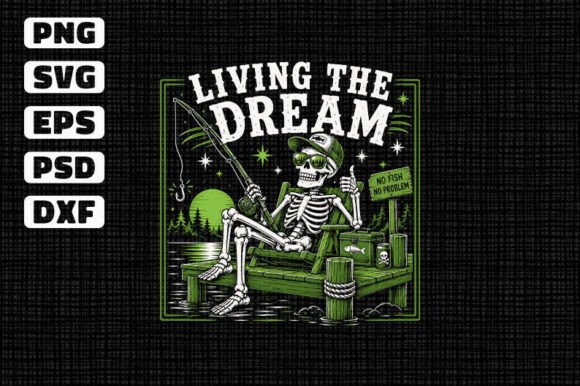
Living the Dream Fishing Skeleton SVG
A Designer’s First Look: Dry Humor, Clean Lines, and Stitch-Ready Personality
When I opened Living the Dream Fishing Skeleton SVG, I didn’t see just another fishing clipart — I saw a confident, slightly irreverent character with real embroidery potential. The stipple-art vector style gives it texture without relying on dense fills, and the skeleton’s relaxed pose — rod in hand, no fish in sight — lands that “No Fish No Problem” vibe instantly. It’s clever, not crass; stylized, not sloppy. As a designer who’s stitched hundreds of novelty motifs for boutique apparel and custom gifts, I immediately pictured this on a heavyweight cotton tote bag for a local fly-fishing shop — not as filler, but as the focal point.
Where This Design Earns Its Keep (and Why It Sells)
Living the Dream Fishing Skeleton SVG shines brightest where personality meets practicality: embroidered patches for outdoor gear, sweatshirt fronts for small-batch apparel lines, and tea towel designs for coastal gift shops. Its balanced negative space means it reads clearly even at 3.5"–4.5" wide — ideal for cap fronts or baby onesies where detail can blur. I tested a mockup on a navy fleece sweatshirt, and the silhouette held up beautifully with medium-weight cutaway stabilizer and matte poly thread. Customers respond to wit like this — especially anglers, teachers, nurses, and anyone who’s ever muttered “living the dream” after a long shift. It adds handmade charm without looking juvenile, which matters when you’re pricing your embroidered patch or personalized gift at $28 instead of $12.
Fabrics & Forms That Play Well — and Those That Don’t
- Tote bags & aprons: Excellent. The open shape anchors well on canvas or denim, and the stipple effect translates into subtle satin-stitch variation — no risk of fill-stitch pooling.
- Sweatshirts & hoodies: Strong performer, especially with proper tear-away + cutaway combo stabilizer. Avoid ultra-thick fleece unless you reduce stitch density manually.
- Baby items & lightweight tees: Use caution. The thin bone outlines and fine rod details may vanish on jersey or bamboo blends. Always test with a running stitch outline first — or simplify the rod to a single line before digitizing.
- Caps & curved surfaces: Works best centered on the front panel — avoid stretching over the crown seam. Reduce overall width by 10% if stitching near the bill curve.
- Dark fabrics: High contrast is built-in, but verify thread color choice against your base. A charcoal gray thread on black twill reads richer than stark white — and looks more intentional.
What This Design Says About Your Brand (Before a Single Stitch)
Using Living the Dream Fishing Skeleton SVG isn’t just about dropping in a graphic — it’s signaling tone. On an Etsy listing for handmade embroidered kitchen towels, it tells buyers: “We get you. We’re skilled, but we don’t take ourselves too seriously.” That builds trust faster than perfect kerning ever could. For craft fair shoppers flipping through embroidered pillow covers, it’s the kind of motif that makes them pause, smile, and ask, “Who made this?” That pause is where sales begin. But it only works if execution matches intent: clean edges, consistent stitch tension, and thoughtful placement. A poorly stabilized version on a stretchy knit will look amateurish — and undercut the very professionalism the design implies.
Real Embroidery Designer Notes (Not Just Theory)
- Always stitch a test on scrap fabric — same weight, same color, same stabilizer stack you’ll use for the final piece.
- Review stitch density before loading. If your embroidery file includes heavy fill areas around the skull or rod handle, consider lightening those zones — especially for lightweight cotton or baby items.
- Check small details in black-and-white mockups. The fishing line and tiny eye sockets must remain legible at your intended size. If they disappear in grayscale, they’ll vanish under thread.
- Confirm licensing for commercial use. Since this is listed as a Graphics product in Crafts, verify whether resale of finished embroidered products (e.g., tote bags, patches) is permitted — and whether digital resale of the SVG itself is allowed.
- Use proper stabilizer for your substrate. Cutaway for knits, tear-away for stable wovens, and fusible + cutaway for towels or napkins where backing must stay invisible.
- Compare light vs. dark fabric backgrounds in your design software. Some stipple patterns lose definition on black — adjust contrast or simplify dots before digitizing.
Final Thought: A Design That Fits Real Life — Not Just the Library
Living the Dream Fishing Skeleton SVG isn’t flashy. It doesn’t need glitter or gradients to stand out. What it does have is quiet confidence — in its composition, its humor, and its adaptability across embroidery projects. I’ve used it for a limited-run batch of embroidered aprons for a tackle shop pop-up, and every customer asked where the design came from. That’s the sign of a strong design asset: it sparks conversation, supports brand voice, and stitches cleanly without constant babysitting. It won’t replace your core monogram collection — but as a seasonal staple, a boutique differentiator, or a go-to for personalized gifts? It earns its spot in your embroidery project queue. Just remember: respect the fabric, honor the stitch, and let the skeleton do the talking.